This article was published By Jacob Owens jowens@cecilwhig.com Dec 5, 2014 Updated Dec 5, 2014
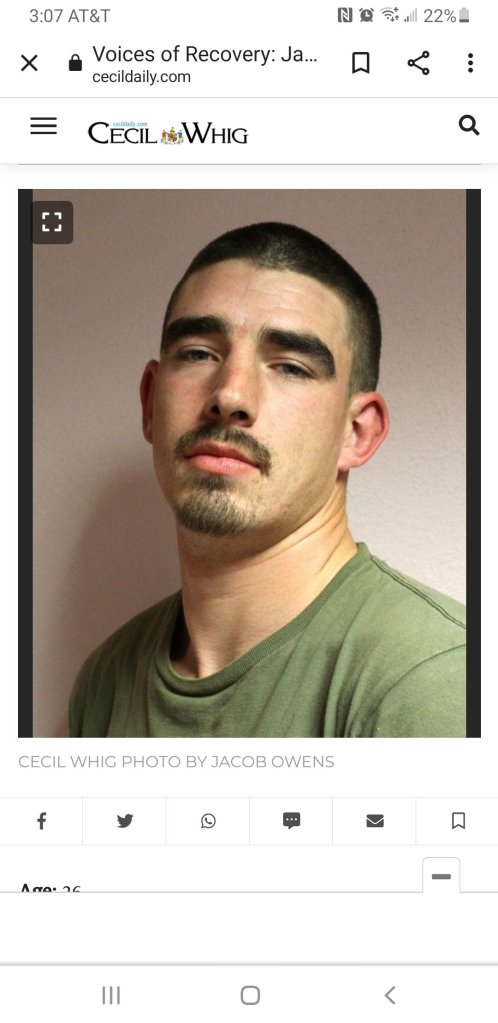
Photo credit: Jacob Owens
This is my story according to my perspective in 2014, with 2 1/2 years clean time and after completing 3 levels of out patient drug programs
Age: 26
Address: Port Deposit
Recovery time: 31 months
ELKTON — Jacob Constien said that he grew up in a house where social drinking and self medicating was not only open, but accepted.
“My dad always had a bag of ‘Skittles,’ where if he hurt his back at work he’d come home and pop a couple of them in a recliner with a couple shots,” he said.
Constien grew up with his grandmother, who lived next door to his parents, and he never developed a relationship with his parents.
“They never really wanted the responsibility of children; they just wanted to party all of the time,” he said. “It was weird growing up, because when I did see my parents, they were usually intoxicated one way or another.
His first brush with substance abuse began with smoking marijuana at age 11 with an older brother and his friends.
“I fell asleep afterwards,” he said. “I was just trying to fit in and find acceptance with this older crowd. My brother is six years older and I idolized him since my parents weren’t around.”
Constien said that he started his schooling at a private school, but a change to the public school system meant he lost his friends. He had trouble fitting in and found himself turning to drugs and alcohol to find acceptance.
He quit school in ninth grade to start working at his father’s construction company, where he said many used illegal drugs or abused prescription painkillers. His father let him drop out of school only if he earned a GED by age 16, which Constien did.
“I got in right on the edge of the boom with pill popping and doctor shopping,” he said. “I had to grow up really fast. I was 15, but I felt like I was 25.”
Constien said he picked up others in the construction crew in his truck and would stop at liquor stores and drug dealers. No one viewed him as a teen, but just one of the rest, he said.
“We’d smoke as much marijuana as we did cigarettes,” he said. “I’d start each day with an Oxycodone 30 mg to feel better. Then when you got off work, the drinking started.”
When he was 17, Constien’s father got sick and went to a doctor in North East, whose license was later revoked by the state for prescription drug offenses. His father was prescribed 540 Oxycodone painkillers a month, approximately $10,000 in drugs, he said.
“That’s when I was off to the races. It was the best I ever felt,” he said.
He said he began peddling pills to support his habit, but his addiction quickly crept into his illicit business. When authorities began cracking down on doctors, and supplies began to dry up, Constien said he began lying, cheating and stealing to support his habit. Ultimately, he received criminal theft and assault convictions that sent him to jail for 17 months.
“While I was in jail, my mother and my father passed away,” he said. “My best friend also committed a drug-related suicide.”
Constien’s lawyer was unable to secure the necessary signatures to allow him to attend any of the three funerals.
“It was then that the Lord said to me, ‘Listen dummy, if you don’t realize everything that you still have and turn you life around, I’m going to take it all from you,’” he said.
Constien said that while he had often thought about seeking treatment and had many opportunities through the legal process, he never made the first step to try to address his addictions.
“I was stubborn, I thought I had it figured out, I thought I could do it on my own,” he said. “Now I know that you can do it and you don’t have to do it on your own.”
While he was in jail, he got a cellmate with a study Bible, and Constien began reading it himself.
“I began reading the Good Book and learning that the stories in it were my stories, just with different people,” he said.
Constien earned the ability to go to work release and was able to talk with Pastor Harold Phillips of Pleasant View Baptist Church in Port Deposit. When he got out, he attended the church and has never left. He moved to Port Deposit to live with a relative in order to avoid the people, places and things that he knew in the North East area.
Constien said that he has found acceptance with the congregation at his church, even surprisingly so from a former police officer.
“When he found out about my past, he didn’t look at me differently, but encouraged me to keep attending,” he said. “I forgot about Bible study the other night, and when this gentleman noticed I wasn’t there, he called me to make sure I knew.”
Constien is now employed as a craftsman and has a girlfriend with a child. He owns his own home.
He implored those thinking about seeking help for his or her addiction to do so.
“There’s a stigma that as soon as you stand up and say, ‘Hello, my name is, I’m an addict,’ you’re going to be branded. It’s real though, and you can’t hide from it, you have to confront it,” he said.
This story is part of a weekly series put together in partnership with the Cecil County Health Department focusing on recovery from addiction. For more information on available treatment services, contact the Cecil County Health Department’s Alcohol & Drug Recovery Center at 410-996-5106, visit www.cecilcountyhealth.org or stop in to 401 Bow St., Elkton, MD 21921.